
- Homepage
- Art Movement
- Authenticity
- Characteristics
- Boxed, On Canvas (2)
- Framed (40)
- Framed, On Canvas (59)
- Framed, On Panel (17)
- Framed, On Wood (10)
- Framed, Signed (10)
- Oil On Paper (2)
- On Canvas (389)
- On Canvas, Framed (5)
- On Canvas, Signed (7)
- On Panel (81)
- On Panel, On Canvas (18)
- On Wood (18)
- On Wood, On Canvas (2)
- On Wood, On Panel (4)
- One Of A Kind (ooak) (3)
- Signed (32)
- Signed, On Canvas (112)
- Signed, On Panel (29)
- Signed, On Wood (7)
- Other (3906)
- Genre
- Abstract (23)
- Académisme (16)
- Art Deco (23)
- Art Déco (40)
- Barbizon (14)
- Baroque (35)
- Classicism (174)
- Classicisme (191)
- Expressionism (176)
- Expressionnisme (90)
- Fauvism (47)
- Fauvisme (16)
- Impressionism (199)
- Impressionnisme (202)
- Orientalism (16)
- Realism (83)
- Romanticism (40)
- Romantisme (34)
- Réalisme (77)
- Voir Photos (33)
- Other (3224)
- Theme
- Animals (26)
- Animated Landscape. (5)
- Architecture (7)
- Art (8)
- Character (68)
- Child (17)
- Figure (7)
- Flower, Tree (18)
- Genre Scene (54)
- History, War (7)
- Hunting, Fishing (4)
- Interior Scene (4)
- Landscape (448)
- Marine (4)
- Portrait (9)
- Portrait / Face (7)
- Religion, Mythology (45)
- Sacred Subject (9)
- Seascape, Boat (58)
- Still Life (119)
- Other (3829)
- Type
Old Table Oil Painting French School Rabbit Hare Fruit Baroque 19th Century

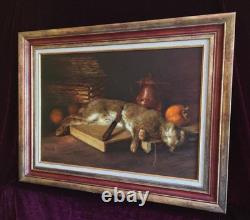
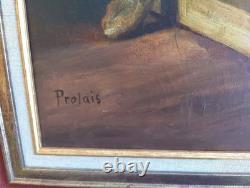
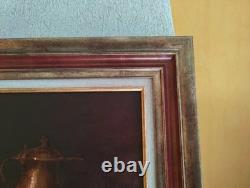
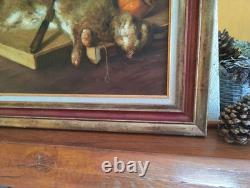
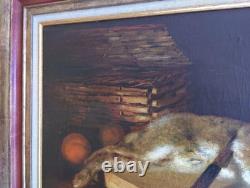
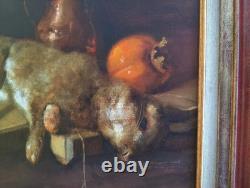
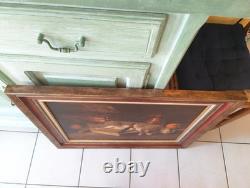
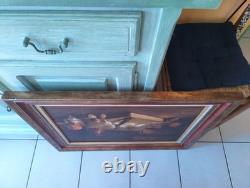
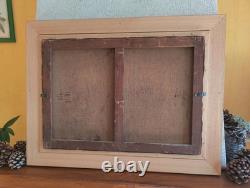


Antique Painting Oil HST French School Rabbit Hare Fruit Baroque 19th Century. Hello, I am selling this painting measuring 44 cm in height and 63 cm in width when considering only the composition, and 62 cm by 80 cm when including its frame. You can find a page on the internet on the site "la seyne en 1900," detailing some juicy aspects of its personality, particularly subversive and dandyish, which made him appear as a gentle original. His tragic and early end, at just 35 years old, occurred when, following yet another argument with his partner, with whom he had an intense relationship in every sense of the word, she, armed with a revolver, shot him in the chest while he had just destroyed the portraits he had created in her honor. Nothing can overshadow his immense talent as a painter, some of which you can see on this same page, which I strongly recommend you consult, and which was not limited to marine scenes as the artist was also a caricaturist, portraitist, and painter of particularly striking still lifes.
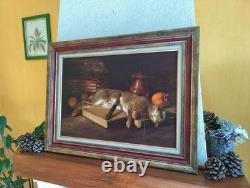
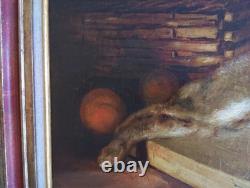
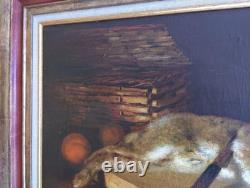
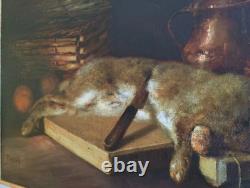
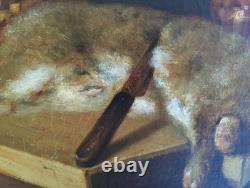
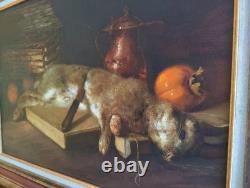
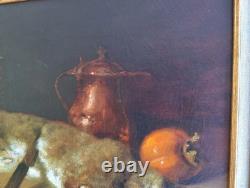
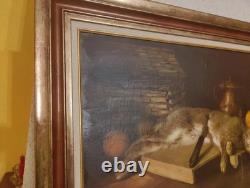
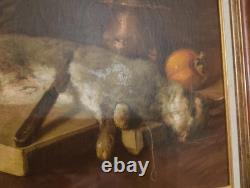
The painting I am offering, a still life, represents a hare placed at the center of the composition, stretched out on a kitchen board, a knife leaning against its flank. The legs and ears extend beyond the board, highlighting the considerable dimensions of this beautiful specimen.
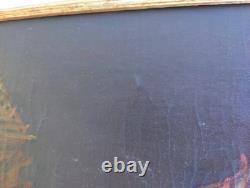
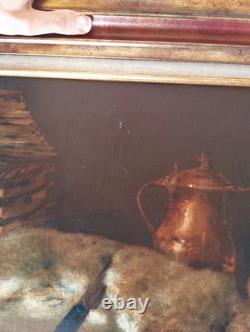
There is something in this posture chosen by the painter and frozen by death that speaks of veneration, a true respect for the life given by this animal, a deep desire to elevate its already elegant appearance in life, as if only death and the artist could capture what cannot be seen otherwise. The feeling of purity that emanates from it is further enhanced by the almost complete absence of apparent violence, unlike some representations of these same Leporids falling into a form of barbarism and/or disrespect for the beast. Thus, one should not be surprised that the presence of this knife slightly embedded in the fur, placed in a particularly delicate manner, its shadow accompanying it, suggests not violence but the density of the fur, superbly rendered from head to paws, with a softness and fluffiness that one can easily imagine to the touch. The other elements that articulate all around—three persimmons, a basket that seems to contain one or two more of these fruits, and a copper coffee pot—complete a composition in which the placement is remarkably judicious and thoughtful, down to the string of the board that fills a void; revealing the painter's mastery, whether in the quality of the line, the rendering of textures, or the judicious combination of certain colors with others; and enjoying a chiaroscuro that accentuates its almost religious dimension and its power of seduction. Despite slight traces of alteration here and there, in the form of small cracks, one of which is more visible between the basket and the coffee pot, at height (a detail quite discreet under ordinary observation conditions) and which lets light through under certain conditions not representing normal observation conditions (the photo revealing this phenomenon was indeed taken backlit), some flaking here and there, particularly at the base of the knife blade, but not presenting any real risk of worsening if care is taken to open it, very discreet paint losses, and a few places where hairs have clung, the painting is in good, even very good overall condition of preservation, and has never been restored or relined.
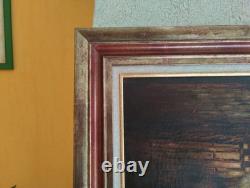
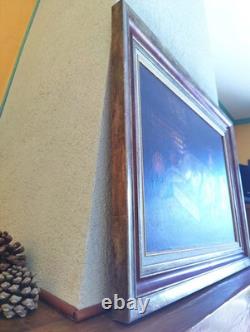
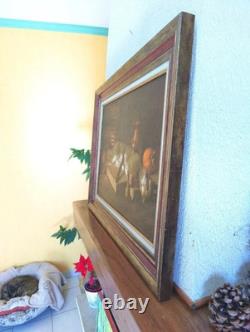
The frame is also in good to very good condition, despite some small material losses here and there and minor signs of wear. The painting is very well secured in its frame, and the tension of the canvas is excellent. Note that the varnish does not seem perfectly uniform, a detail that is only visible with reflections (last photos). The vast majority of the photos were taken on a sunny afternoon in a very well-lit room, using the natural light coming from a regular window on the right side. After numerous tests, I realized that the color rendering in the second and third photos, with my equipment, is the one that most faithfully reproduces, regardless of the distance, what can be observed under similar conditions. However, note that computer or mobile phone screens other than mine, depending on their brightness and contrast, may modify the results I have achieved to a greater or lesser extent. With these elements in mind, you can nevertheless consider these snapshots as sufficiently representative of reality, under observation conditions similar to those described earlier.The third photo gives an idea of the scale of the elements represented in the painting. Attention to collectors, those attracted to vintage items, curiosities, decorative objects, or simply admirers of their intrinsic beauty! It is an excellent gift idea. Shipping will be done seriously, unless you prefer a pickup, which is entirely possible if you make the trip.
Shipping to the United States is currently impossible due to new customs regulations until further notice. The dimensions of the package, with a size greater than 150 cm, classify it as bulky.
To ensure that insurance is effective, it is imperative that if the carton is damaged, sufficiently (it is up to you to determine upon inspection) in any area, and/or opened, even partially, you ask the delivery person to note reservations if it is a shipment with the Post, or that you refuse the package with the staff at the relay point if it is a relay point shipment, UNLESS, you will need to ask them, you have the option to note reservations with the scanning device of the shipping receipts—then you can receive the package—before they scan the shipping receipt or perform any other operation confirming that you have indeed retrieved the package; in other words, make sure to check the condition of the carton thoroughly, leaving no spot out, in both cases before they take action. In the case of a relay point delivery, if your refusal to accept is articulated, the package will be kept by the relay point to be returned to the expertise service, for verification aimed at reporting the responsibility of the delivery personnel and making the insurance effective (elements gleaned from their site) in the event that the item is damaged. Regarding the Post, if delivery occurs in your mailbox because the dimensions of the package allow it, without personal delivery, and the carton is sufficiently damaged (a nuance that is up to you to determine), you should take it back to the nearest postal point without having opened it, asking the counter staff to return the package to me (information collected from their site), also in anticipation of a verification by the delivery service, UNLESS, as with the relay point delivery, the postal office staff can indicate reservations. In all cases, do not hesitate to take photos of the damaged and/or opened carton. You may think, for any reason, that the item inside the carton remains in perfect condition, despite the damaged box, sufficiently (it is up to you to determine upon inspection), and/or opened, even partially, and therefore that you do not request to make reservations, or that you accept the package if making reservations is not possible; but be aware that this amounts to playing Russian roulette since the delivery services rely on the error factor, which incidentally suits them well since, I repeat, the insurance is then no longer effective due to the sacred transfer of responsibility from the deliverer to the sender or the recipient; less expense for them since they will not have to pay the insurance amount! And do not count on a "shake" of the package to determine if the item is broken; unless it is glass or ceramic, the noise of breakage is imperceptible, or it could be a protective element in the package.Be sure to communicate all these elements in case a third party is picking up the package on your behalf. If, on the other hand, the condition of the returned item is different from what it was when I sent it, but no evidence allows us to determine that the delivery personnel are responsible, then there will be no refund, for the reason that even with excellent packaging it can happen that not only the shocks during transport are extremely significant but also that this occurs without any external damages, that is to say, on the carton. Things that may not have happened during the initial shipment, and that could perhaps have been avoided if the buyer had retrieved the package and thus prevented a second transport, theoretically involving twice the risks for the item.
If you have any questions or would like more photos, feel free to let me know.