
- Homepage
- Art Movement
- Authenticity
- Characteristics
- Boxed, On Canvas (2)
- Framed (40)
- Framed, On Canvas (59)
- Framed, On Panel (17)
- Framed, On Wood (10)
- Framed, Signed (10)
- Oil On Paper (2)
- On Canvas (386)
- On Canvas, Framed (5)
- On Canvas, Signed (7)
- On Panel (81)
- On Panel, On Canvas (18)
- On Wood (18)
- On Wood, On Canvas (2)
- On Wood, On Panel (4)
- One Of A Kind (ooak) (3)
- Signed (32)
- Signed, On Canvas (112)
- Signed, On Panel (29)
- Signed, On Wood (7)
- Other (3905)
- Genre
- Abstract (23)
- Académisme (16)
- Art Deco (23)
- Art Déco (40)
- Barbizon (14)
- Baroque (35)
- Classicism (174)
- Classicisme (191)
- Expressionism (176)
- Expressionnisme (90)
- Fauvism (47)
- Fauvisme (16)
- Impressionism (198)
- Impressionnisme (202)
- Orientalism (16)
- Realism (83)
- Romanticism (40)
- Romantisme (34)
- Réalisme (77)
- Voir Photos (33)
- Other (3221)
- Theme
- Animals (26)
- Animated Landscape. (5)
- Architecture (7)
- Art (8)
- Character (68)
- Child (17)
- Figure (6)
- Flower, Tree (18)
- Genre Scene (54)
- History, War (7)
- Hunting, Fishing (4)
- Interior Scene (4)
- Landscape (446)
- Marine (4)
- Portrait (9)
- Portrait / Face (7)
- Religion, Mythology (45)
- Sacred Subject (9)
- Seascape, Boat (58)
- Still Life (119)
- Other (3828)
- Type
Antique Oil Painting on Wood, Flemish School of Barbizon, 17th–18th–19th Century
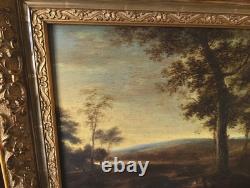
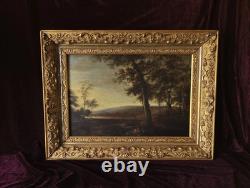
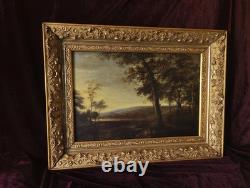
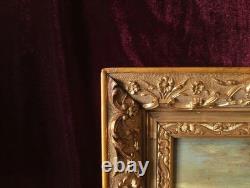

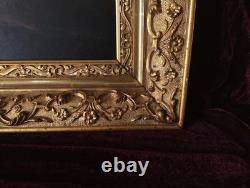
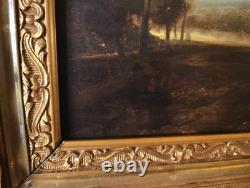
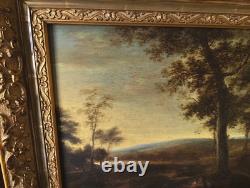
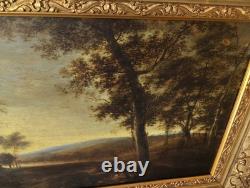
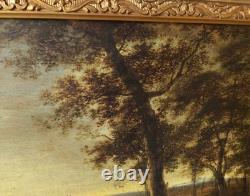
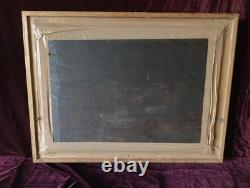
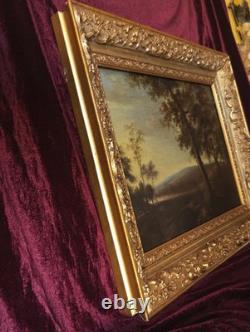




Hello, I am offering this painting for sale. The wooden panel itself measures approximately 55 cm wide by 40 cm high, or around 65 cm wide by 50 cm high including the frame.
This is a superb oil painting on a wooden panel.
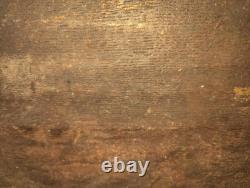
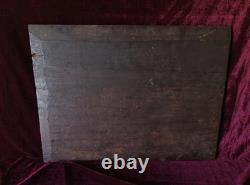
The wood also shows considerable oxidation, giving it a great deal of character.
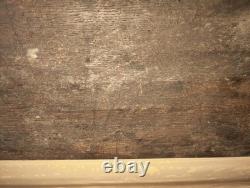
Despite searching carefully, I have found no signature, only some curious markings on the back of the panel, visible in the last photos.
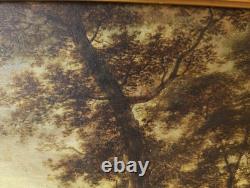
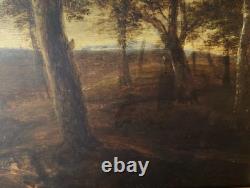
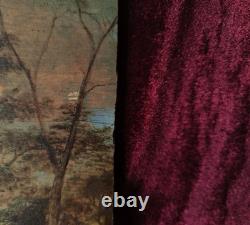
The dimensions—55 by 40 cm, both round numbers or very close to them—the presence of several figures, and the highly naturalistic style of the composition all suggest the work of a Flemish school with considerable mastery of both technique and artistic intention. At times, the detail is almost obsessively meticulous, with patches of foliage where each leaf seems to have been painted individually, and features such as a bird, circled in red in the twelfth photo. Elsewhere, the painting displays a striking purity.
More than simply depicting a rural landscape, this painting captures it with all the magic associated with the finest artists influenced, to turn briefly to France, by the Barbizon school. It is the same magic those talented painters knew how to breathe into their works.
There is something dreamlike about this dawn scene, inviting us to imagine the clouds drifting gently across the sky. We witness the emergence of beautiful effects of light, dominated by a soft, veiled pale yellow, with very slight hints of blue-grey here and there—the lingering traces of night—and even subtler touches of green, barely noticeable but unmistakably present.
Consider for a moment that, to capture light of such purity, faithful to even its slightest nuances, the painter must surely have waited on location for the very first ray of daylight. Perhaps he even spent part of the night there, awaiting release from the darkness, taking time to prepare his materials, sharpen his eye, and absorb the atmosphere of the surrounding landscape deep within himself, despite the cold, the wind, and the numbness of a hand impatient to reproduce his heightened vision. He may have repeated this routine over several days or weeks.
A work with such soul could hardly have come into being otherwise.
There are various signs of wear here and there. Some figures have very faded outlines and textures, almost seeming to disappear, such as the two men and a dog in the foreground. Yet this only enhances the rendering of the light and the natural surroundings.
Together, they give the painting an appearance that can be described—and this is rare enough to deserve mention—as a remarkable patina: a harmonious surface on which no individual blemish truly distracts the eye, offering an exceptionally authentic record of the work’s passage through time.
This patina is enhanced by the judicious application of a light varnish, which provides protection and an attractive satin sheen.
I have not identified any retouching or other restoration work.
The wooden panel is thick, particularly in certain areas, and conveys a sense of quality and strength. It is perfectly flat and straight.
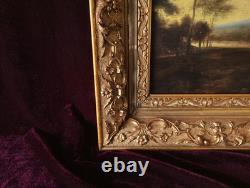
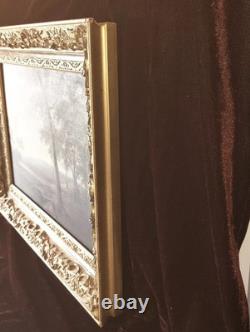
The superb 19th-century frame—hence the reference to the 19th century in the listing title—suits the painting perfectly. It is in good to very good overall condition, with some signs of wear and a few losses that have been discreetly touched up here and there.
It, too, is remarkably sturdy.
Please note that the upper and lower sections of the frame have been “enlarged” to accommodate the panel, but this does not affect the frame’s strength.
The adhesive tape used to hold the panel in place, although it might be regarded as a temporary solution, is surprisingly effective. It is easy to remove while being sufficient to prevent the panel from falling out or slipping. Nevertheless, you may wish to consider an even more durable solution that poses no risk over the long term.
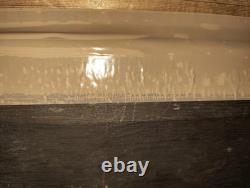
The photos were taken in natural light on a sunny afternoon, in a very well-lit room. The second and third photos give a reasonably accurate impression of the actual colours under those conditions, although some variation is possible depending on the lighting in your home and the display settings of the screen you use to view the listing.
Please note that the appearance of the back of the wooden panel, including its colour, is closest to that shown in the fourteenth photo; the twenty-first photo is less accurate. The reflections visible in the second photo are more pronounced than they are when viewing the painting directly from the front, where they are much less noticeable.
Collection in person is entirely possible if you are able to travel here.
For insurance coverage to apply, if the box is sufficiently damaged anywhere—you must judge the extent of the damage when inspecting it—and/or has been opened, even partially, it is essential that you ask the delivery person to formally record your reservations about its condition if it is being delivered by La Poste.
If it is being delivered to a parcel collection point, you must refuse the parcel, UNLESS the staff can record your reservations using the device they use to scan shipping labels. You will need to ask them whether this is possible.
If it is, you may then accept the parcel, but your reservations must be recorded before they scan the shipping label or carry out any other action confirming that you have collected it.
In other words, in either situation, ask to inspect the entire box carefully, without overlooking any part of it, before they proceed.
For delivery to a parcel collection point, if you refuse to accept the parcel, it will be retained there and returned to the assessment department.
For delivery by La Poste, if the parcel is small enough to be left in your letterbox rather than handed to you personally, and the box is sufficiently damaged—you must judge the extent of the damage—you must take it, unopened, to your nearest post office and ask the counter staff to return it to me. This information was also obtained from their website.
Again, this is so that the delivery service can investigate, UNLESS, as with delivery to a collection point, the post office staff can formally record your reservations.
In all cases, do not hesitate to take photos of the damaged and/or opened box.
For whatever reason, you may believe that the item inside is still in perfect condition despite the box being sufficiently damaged—you must assess this during inspection—and/or opened, even partially. You might therefore choose not to ask for your reservations to be recorded, or accept the parcel when recording reservations is not possible.
Please understand, however, that this amounts to playing Russian roulette.
This means less expense for them, since they will not have to pay out the insured amount!
Do not rely on shaking the parcel to determine whether the item is broken, either. Unless the item is made of glass or ceramic, damage may produce no audible sound.
Please make sure all this information is passed on to anyone collecting the parcel on your behalf.
If, however, the returned item is in a different condition from when I sent it, and there is no evidence establishing that the delivery service is responsible, no refund will be issued.
This is because, even with excellent packaging, a parcel can suffer extremely severe impacts in transit without any visible damage to the outer box.
Such damage might not have occurred during the initial shipment and might have been avoided if the buyer had accepted the parcel, thereby preventing a second journey, which theoretically exposes the item to twice the risk.
If you have any questions or would like more photos, please do not hesitate to contact me.