
- Homepage
- Artist
- Authenticity
- Height
- Theme
- Animals (26)
- Animated Landscape. (5)
- Architecture (7)
- Art (8)
- Character (68)
- Child (17)
- Figure (7)
- Flower, Tree (18)
- Genre Scene (54)
- History, War (7)
- Hunting, Fishing (4)
- Interior Scene (4)
- Landscape (451)
- Marine (4)
- Portrait (9)
- Portrait / Face (7)
- Religion, Mythology (45)
- Sacred Subject (9)
- Seascape, Boat (58)
- Still Life (121)
- Other (3835)
- Type
- Width
Antique Portrait of Fouché, 18th Century, Oil on Canvas, 1 Piece










Antique 18th-Century Portrait Attributed to Fouché, Oil on Canvas, 1 Piece
This product listing has been automatically translated. If you have any questions, please do not hesitate to contact us.
Attributed to Nicolas Fouché, also known as Foucher (Troyes, 1653 – Paris, 1733).
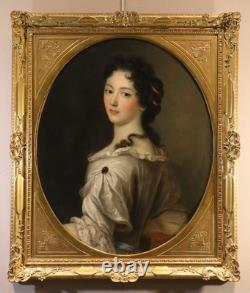
Portrait of Marie-Thérèse de Bourbon (Paris, 1666 – Paris, 1732), Princess of Conti.
Oil on canvas, 73 x 59 cm.
With gilt frame, 88 x 74 cm.
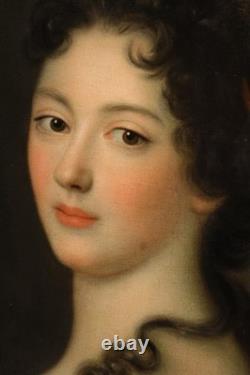
The beautiful young woman depicted in this painting is the French princess Marie-Thérèse de Bourbon-Condé (1666–1732), also known as the Princess of Conti following her marriage to François Louis de Bourbon-Conti. A member of the French royal dynasty, she was born in Paris to Henri Jules de Bourbon-Condé, Prince of Condé, and Anne Henriette of the Palatinate.
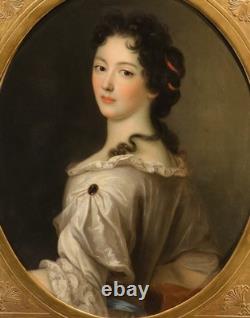
The noblewoman is portrayed from behind, with her upper body turned as she looks directly at the viewer. Her delicate features are distinguished by a fair complexion and cheeks lightly flushed with rouge, against which her large, dark eyes stand out.
Her curly brown hair is arranged in an elaborate style typical of the French court of the period, adorned with a red ribbon tied among the curls. A long, soft ringlet falls over her left shoulder.
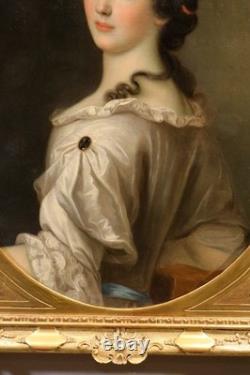
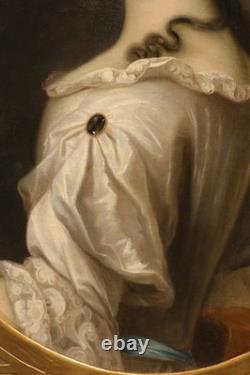
The princess wears a low-cut gown of lustrous white silk that catches the light in soft folds. It features wide sleeves and a generous neckline and is cinched at the waist with a pale blue sash. The sleeve is finely gathered at the shoulder with a precious dark clasp, possibly a cameo, and finished with delicate lace embroidery.
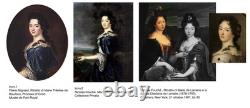
As was often the case with exceptionally beautiful women of the high nobility, she became the subject of portraits by the most celebrated painters at the French court in the late 17th and early 18th centuries, including Nicolas de Largillière, François de Troy, Hyacinthe Rigaud and Pierre Mignard. Mignard painted her official—and perhaps best-known—portrait in 1691, now held at the Musée de Port-Royal.
To this distinguished list of names we should add Nicolas Foucher (Troyes, 1653 – Paris, 1733), to whom this painting is attributed. He was a leading portraitist of the French school in the late 17th and early 18th centuries.
He spent much of his career in Paris, first as a pupil and then as a collaborator of Pierre Mignard, adopting his master's compositional models and a style distinguished by grace and delicacy.
Fouché is also known for other depictions of the princess.
For example, a refined three-quarter-length portrait in which she wears a blue dress and holds daisies has been attributed to him (Image 2). That painting is comparable in period and reflects Mignard's compositions in both style and pose, to such an extent that attributions to the two artists have often been confused on the antiques market.
Although his works are relatively rare, they demonstrate a mastery of decorative refinement.
Following Mignard's example, he moved away from the monumental rigidity of some contemporaries, such as Charles Le Brun, favouring flowing lines, subtle tonal transitions and an exceptionally fluid, silky rendering of fabrics.
For comparison, we can cite the portrait of Marie de Lorraine and her younger sister Charlotte de Lorraine (Image 3). The depiction of Marie closely mirrors the present painting: we find the same refined features and a similar three-quarter view of the face, with the head slightly tilted.
Fouché's subjects are distinguished by a uniquely graceful classicism, associated with what was then known as mignardise—a delicate, charming refinement. Their faces display idealised features, serene expressions and smooth, fair complexions, intended to flatter and ennoble the Parisian aristocracy.
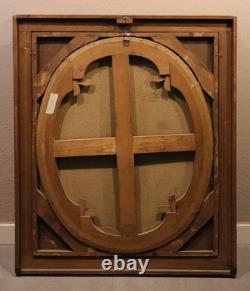
The painting is in good condition, with minor restorations and scattered retouching. It is set in an ornate rectangular giltwood frame, finely carved with floral motifs, garlands and geometric scrollwork at the corners.
The work is sold with a certificate of authenticity and a descriptive iconographic information sheet.
We arrange and manage shipping for purchased artworks within Italy and internationally through professional, insured carriers.
Please contact us for further information; we will be happy to assist you. You are also welcome to view the painting at our gallery in Riva del Garda, where we would be delighted to show you our collection.
This painting is comparable in period and reflects Mignard's compositions in both style and pose, to such an extent that the two attributions…